
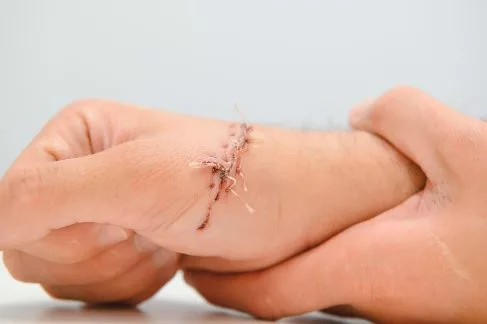
A Deep split laceration happens when blunt force pushes the skin against an underlying bone until the tissue tears apart, rather than being cut by a sharp object. It usually has jagged, uneven edges and shows up on areas where skin sits close to bone, such as the scalp, eyebrow, chin, elbow, or knee. This guide covers what causes this injury, its symptoms, how it differs from other wound types, and realistic healing timelines.
A split laceration is a wound caused by blunt trauma that stretches skin beyond its limit until it splits open. There is little soft tissue cushioning the skin from the bone below, which is why it’s so common on the scalp, forehead, and shin.
Doctors often describe a split laceration as deceptively simple on the surface but messier underneath than it looks. Because the tearing comes from pressure rather than a sharp edge, the edges are usually irregular, bruised, and prone to heavy bleeding, especially on the scalp where blood vessels sit close to the surface.
Not every open wound is the same, and comparing this injury with other types of laceration helps clarify what makes it distinct.
There are several recognized types of lacerated wound, each with its own mechanism:
● Blunt-impact tear – caused by force compressing skin against bone until it tears; edges are jagged and bruised.
● Avulsion laceration – a flap of skin and tissue is partially or completely torn away, sometimes exposing structures underneath.
● Stretch laceration – skin is pulled sharply, tearing in a straight or curved line, common in slip-and-fall accidents.
● Incised wound – a clean cut from a sharp object like glass or a knife, with smooth, straight edges.
● Crush wound – heavy, compressive force damages both skin and deeper tissue.
Knowing these types of laceration helps first responders and clinicians predict bleeding patterns, underlying tissue damage, and the closure method needed.
People often confuse a scrape with a tear, so it helps to clarify abrasion vs laceration. An abrasion only scrapes off the top layer of skin, similar to road rash, and rarely goes through the full skin thickness. A true tear goes deeper, sometimes reaching muscle, fat, or bone. This injury always falls into the deeper category, since it involves a full tear through the skin layers rather than surface scraping.
A split laceration typically results from a direct blow against a hard surface. Common causes include:
1. Falls – Hitting the head, eyebrow, chin, elbow, or knee against a floor, table edge, or curb.
2. Sports injuries – Contact sports like football, basketball, or hockey often cause this eyebrow or scalp injury from a collision or elbow strike.
3. Motor vehicle accidents – Sudden impact against a dashboard, steering wheel, or window frame.
4. Workplace accidents – Falling objects or contact with machinery.
5. Household accidents – Slipping in the bathroom, tripping on stairs, or bumping into furniture corners.
6. Physical altercations – A punch or blunt object striking bony areas like the brow or cheekbone.
In every case, force compresses skin against bone with nowhere for the tissue to go, so it tears rather than bends — a pattern typical of this laceration injury.
Recognizing a split laceration quickly helps determine how urgently it needs care.
Typical symptoms include:
● A visible tear or gap in the skin with ragged, ill-defined edges
● Heavy or rapid bleeding, particularly on the scalp or face
● Swelling and bruising around the wound
● Pain or tenderness at the site of impact
● Visible fat, muscle, or in severe cases bone at the base of the wound
● A deep or “gaping” appearance even when the wound looks short
● Numbness or tingling, which can indicate nerve involvement
Because this wound often occurs alongside blunt trauma, it may come with a headache, dizziness, or a visible lump — especially with a scalp laceration, which should prompt evaluation for possible concussion.
A scalp laceration is one of the most frequent versions of this injury, since the scalp has a rich blood supply and very little cushioning between skin and skull. Even a minor bump can bleed far more than its size suggests, and blood loss alone doesn’t reflect how serious the underlying injury is. Any scalp laceration following a fall or head impact should be checked for concussion or skull injury, not just treated as a surface wound.
When someone arrives at a clinic with this kind of wound, a provider typically will:
● Clean the wound and examine its depth, length, and edges
● Check for foreign debris such as dirt, glass, or gravel
● Assess for nerve, tendon, or blood vessel damage
● Evaluate surrounding bone for fracture, particularly with facial or scalp wounds
● Ask about the mechanism of injury, since blunt trauma is managed differently than a sharp-object wound
● Order imaging, such as an X-ray or CT scan, if a fracture or embedded object is suspected
This assessment determines whether the wound needs stitches, adhesive strips, surgical glue, or more advanced repair.
Treatment depends on depth, size, and location, but common approaches include:
● Wound cleaning – Thorough irrigation to remove debris and reduce infection risk.
● Closure – Sutures, staples, adhesive strips, or skin glue, depending on depth and tension.
● Pressure and bandaging – To control bleeding, especially for scalp wounds.
● Tetanus check – Verifying vaccination status, since blunt trauma carries infection risk.
● Pain management – Local anesthesia during closure and mild relief afterward.
● Antibiotics – Prescribed if the wound is contaminated or at high infection risk.
Because edges are often uneven and bruised, doctors may trim damaged tissue before closing so the wound heals with a cleaner line and less scarring.
Split laceration healing time varies based on size, depth, location, and aftercare. As a general guide:
● Superficial wound: 5–10 days for the skin to close, with internal healing continuing for a few weeks.
● Moderate wound with stitches: Removed in 7–14 days; facial wounds often sooner (5–7 days), joint areas later (10–14 days).
● Deep wound: Can take weeks to months for full tissue strength, with scarring changing for up to a year.
● Scalp laceration: Often heals within 1–2 weeks thanks to strong blood flow, though swelling can linger longer.
Healing speed also depends on age, nutrition, underlying health conditions like diabetes, and whether infection develops. Keeping the area clean, moisturized once closed, and protected from sun exposure can reduce how visible the resulting scar becomes.
Not every laceration injury needs emergency care, but this wound should be evaluated by a medical professional if:
● It is longer than half an inch or appears deep
● Bleeding doesn’t stop after 10–15 minutes of direct pressure
● The edges gape open or you can see fat, muscle, or bone
● It’s on the face, near a joint, or on the scalp
● There’s numbness, weakness, or loss of movement nearby
● Signs of infection appear later, such as redness, warmth, swelling, or pus
● The injury involved a fall with head impact, dizziness, or confusion
Prompt care improves healing outcomes and lowers the chance of noticeable scarring or complications.
A split laceration is one of the most common blunt-force injuries, especially in areas like the scalp, eyebrow, chin, and shin where bone lies close beneath the skin. It may resemble a sharp-object cut at first glance, yet a split laceration tends to have ragged edges, more bruising, and heavier bleeding. Prompt cleaning, proper closure, and attentive aftercare support smooth healing and lower infection risk. If a wound looks deep, won’t stop bleeding, or followed a hard blow to the head, seeking medical evaluation is always the safer choice.
